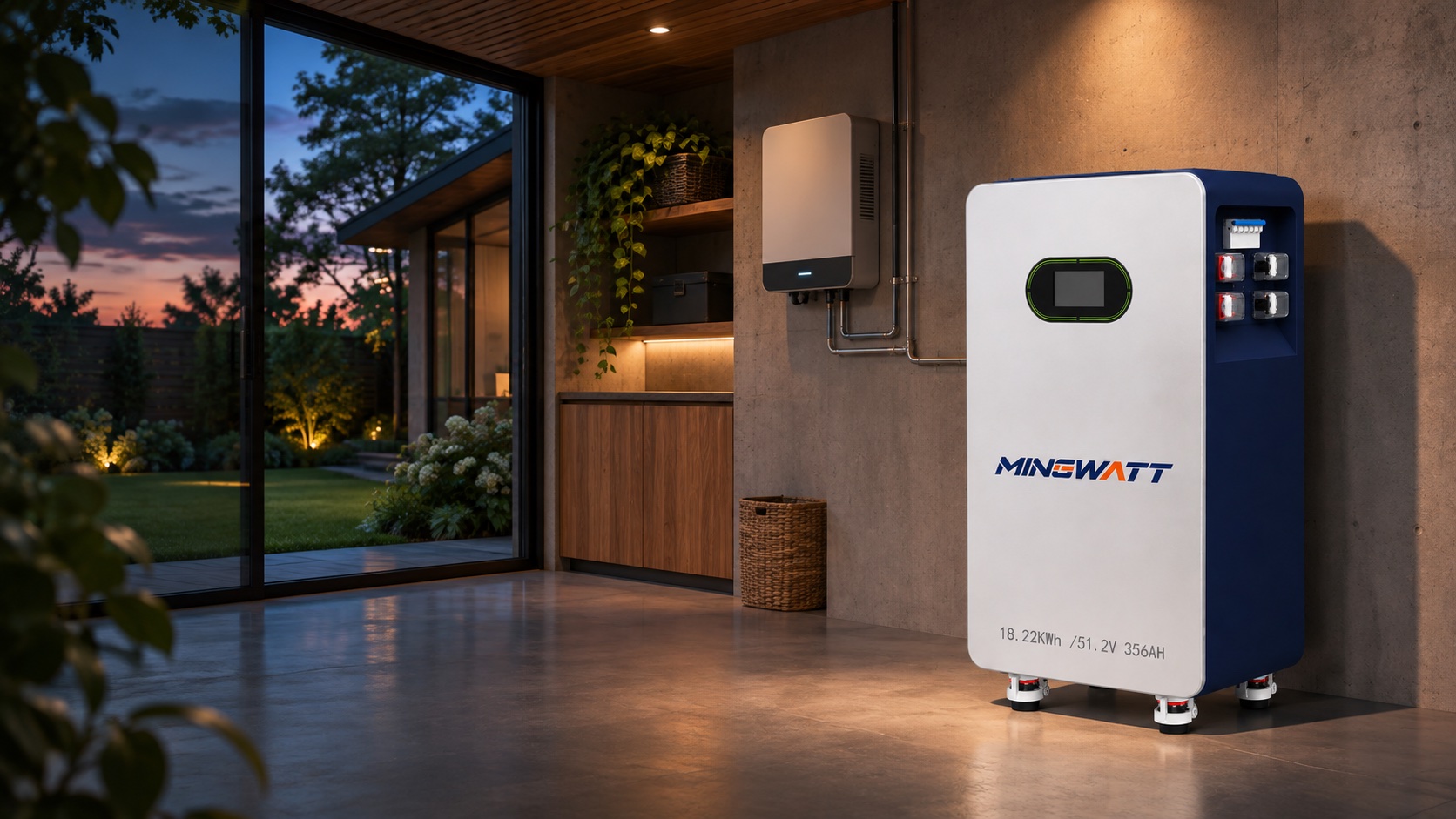
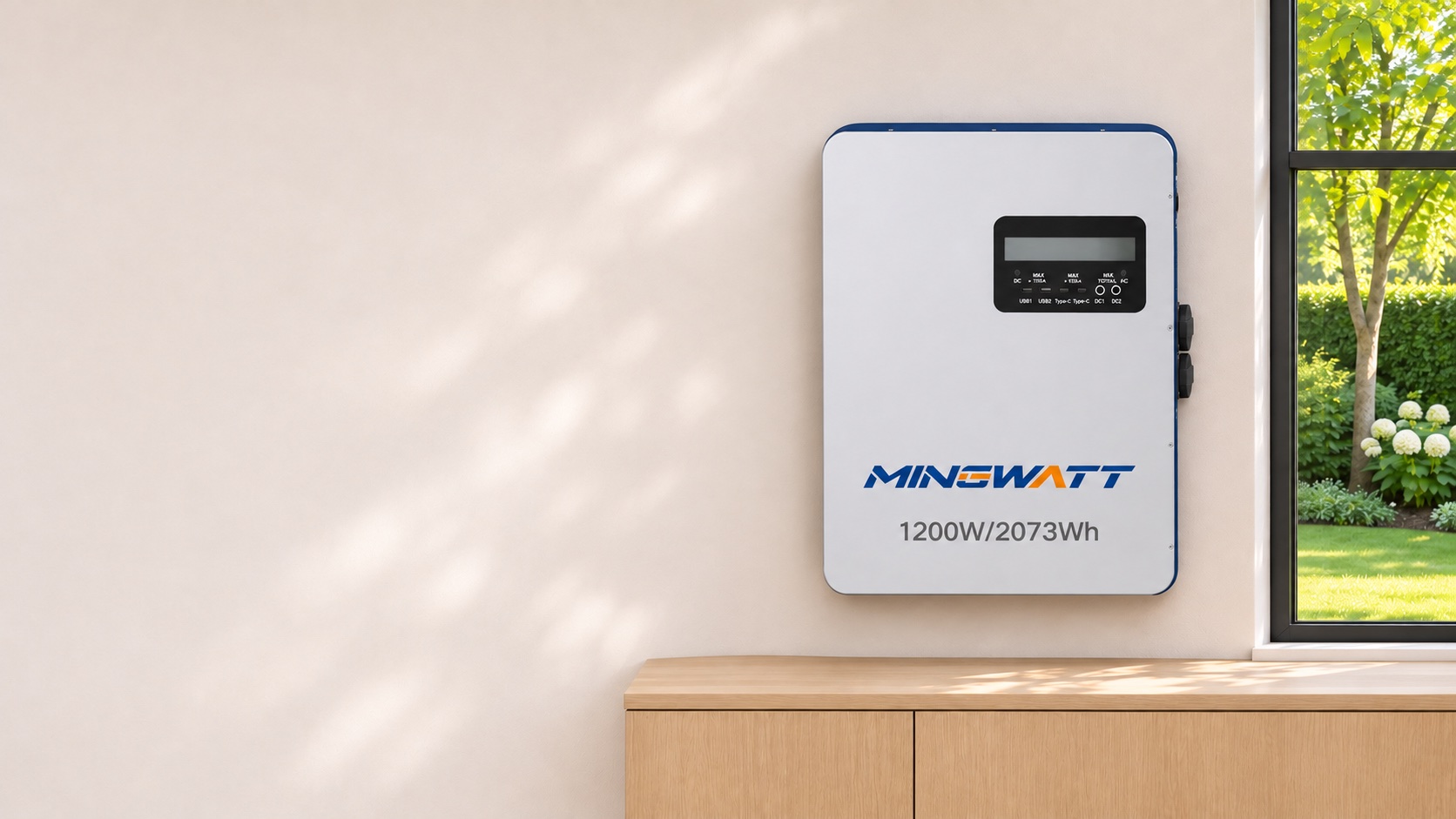
Application concept rendering. Installation, equipment and final product configuration vary by project.
HOME BATTERY SELECTION GUIDE
Choose energy capacity and output power separately.
Energy: how long?
Battery energy is measured in kWh. Start with the equipment you want to support, its typical power consumption and the number of hours it needs to run.
Power: how much at once?
Power is measured in kW. Check simultaneous loads and starting surges. A larger battery capacity alone does not establish the inverter output or the battery's permitted discharge current.
A simple planning example
An average 500 W load running for 6 hours needs 3 kWh at the load: 0.5 kW × 6 h = 3 kWh. The battery must also account for conversion losses, usable-energy limits and the required reserve.
This is a planning example, not a runtime promise for a MINGWATT model. Use measured consumption where possible and review intermittent loads, standby power and starting requirements.
Five checks before comparing 8, 15 and 18 kWh options
- Decide the operating goal. Identify essential-load backup, evening solar use or another application. Record daily energy demand and the desired backup period.
- Check usable energy. Confirm the exact model's nominal energy, permitted operating range and reserve. Capacity labels alone do not establish delivered AC energy.
- Match the inverter. Review battery voltage range, charge and discharge current, communication requirements and any supported configuration for the exact inverter model.
- Review charging and installation. Identify the charging source, available charging time, location, mounting space and environmental conditions. Installation must follow the applicable product instructions and local requirements.
- Validate the complete configuration. Agree sample testing, documentation and acceptance criteria before a volume order. Expansion and parallel operation require model-specific approval.
Battery-only storage
The 8, 15 and 18 kWh class range needs a compatible external inverter for AC loads. Send the inverter brand, model and configuration for review.
Integrated wall-mounted system
The 2073 Wh model includes a 1200 W inverter. Check stored energy and output power independently, together with AC voltage, frequency, sockets and charging inputs.
Buying for a regional product range? Review wholesale cooperation →
Further reading: Australian Government guidance on battery capacity and power. General guidance does not replace model-specific documentation.
8, 15 or 18 kWh: how should you shortlist a home battery?
Start with energy needed during the backup period, then check usable battery energy, inverter output and the time available to recharge. These examples describe loads, not guaranteed MINGWATT runtimes.
Essential loads
A measured average load of 500 W for 8 hours needs 4 kWh at the appliances. Review the 8 kWh class as a starting point only after checking losses, reserve and permitted discharge.
Longer overnight backup
A measured average load of 1 kW for 10 hours needs 10 kWh at the appliances. Compare the 15 and 18 kWh classes using confirmed usable energy, not the capacity label alone.
Higher simultaneous demand
A larger battery does not by itself approve a larger appliance load. Check inverter continuous output, startup capability and battery current limits separately.
Will adding a battery keep my whole house running during a blackout?
Not automatically. Backup capability depends on the inverter, isolation and transfer arrangement, selected circuits and installation design. Ask your installer to define which loads remain powered during an outage.
What should I send for an existing inverter compatibility review?
Send the exact inverter model, firmware if known, battery voltage range, charge/discharge limits, communication requirements and current wiring configuration. A shared connector or nominal voltage is not proof of compatibility.
What if I do not know my average load?
List the appliances, their rated power, expected operating hours and which run together. Add measured consumption if available. Our project brief accepts incomplete information; unknown items can be reviewed before product selection.
General reference: battery storage and outage backup configuration. This does not establish product eligibility or local installation approval.